Abu Rayhan al-Biruni (973–1050 CE) was one of the most towering polymaths of the Islamic Golden Age. Long before the concept of interdisciplinary science existed, al-Biruni was casually mastering astronomy, mathematics, physics, geography, history, and anthropology.
Historians often call him the “Da Vinci of Islam” or the “First Anthropologist,” but even those titles struggle to capture the sheer scope of his precision and forward-thinking mind.
Early Life and Turbulent Times
Al-Biruni was born in 973 CE in Kath, Khwarazm (modern-day Uzbekistan). The suffix “al-Biruni” literally means “from the outskirts,” hinting that he was born in the suburbs of the city.
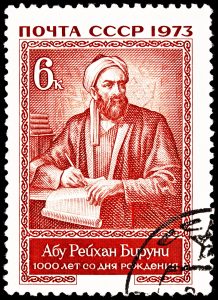
USSR- CIRCA 1973: A stamp printed in the USSR commemorates the 1000th anniversary of the birth of Abu Rayhan Al-Biruni, a Muslim scholar, circa 1973.
He grew up in a period of intense political volatility. Central Asia was a patchwork of warring dynasties, meaning al-Biruni spent much of his life fleeing cities, shifting allegiances, and working under different royal patrons just to keep his research funded.
Despite the chaos, his brilliant mind was recognized early. He studied under the famous mathematician Abu Nasr Mansur, who introduced him to advanced Euclidean geometry and Greek astronomy. By his late twenties, al-Biruni was already exchanging intellectual, and often heated, letters with another young genius of his era: Ibn Sina (Avicenna).
The Captive Scholar and India
In 1017 CE, the powerful sultan Mahmud of Ghazni conquered Khwarazm. Mahmud swept up the local intellectuals—including al-Biruni—and brought them back to his capital in Ghazni (modern-day Afghanistan) as court scholars.
While al-Biruni’s status was technically that of a well-treated political hostage, he used the opportunity to accompany Mahmud on military campaigns into the Indian subcontinent. This travel changed the course of historical scholarship.
Fascinated by Hindu culture, al-Biruni did something unprecedented for his time: he learned Sanskrit, read original religious texts, and deeply studied Indian society. The result was his masterpiece, Kitab al-Hind (The Book of India).
The Birth of Anthropology: Unlike other medieval writers who dismissed foreign cultures as “barbaric,” al-Biruni approached India with objective neutrality. He documented their customs, math, and philosophy without religious bias, earning him the title of the world’s first true anthropologist.
Ab_ al-Ray__n Mu_ammad ibn A_mad al-B_r_n_ (born 5 September 973 in Kath, Khwarezm, died 13 December 1048 in Ghazn, known as Alberonius in Latin and Al-Biruni in English,
Groundbreaking Scientific Achievements
Al-Biruni wrote over 146 titles, though only about 22 have survived. What remains shows a man centuries ahead of his time.
1. Measuring the Earth (Geodesy)
Perhaps his most famous stunt happened at Fort Nandana (in modern Pakistan). Without advanced tools, satellites, or matching modern tech, he calculated the radius of the Earth using a novel trigonometric method involving a mountain height and the dip of the horizon.
His calculation came out to 6,335.7 kilometers.
The actual modern value? 6,371 kilometers. He was off by less than 1%.
2. Astronomy and the Earth’s Rotation
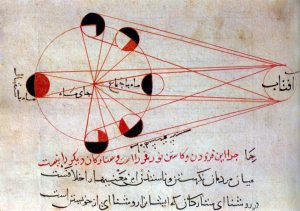
Al-Biruni designed complex instruments and drew highly precise celestial mechanics diagrams. While he officially stuck to the geocentric model (the universe revolving around Earth), he openly wrote that a heliocentric model—where Earth rotates on its axis and orbits the sun—was completely logical and mathematically sound.
3. Predicting the Americas
By mapping the known world and calculating its weight, al-Biruni noticed a massive gravitational imbalance. He deduced that there must be an unknown landmass in the vast ocean between Europe and Asia to balance the globe out. In essence, he logically predicted the existence of the American continents hundreds of years before Columbus sailed.
Final Years and Legacy
After Sultan Mahmud died, al-Biruni remained in Ghazni under the rule of Mahmud’s son, Mas’ud, who was a much more appreciative patron of pure science. Al-Biruni dedicated his massive astronomical encyclopedia, the Mas’udic Canon, to him.
Al-Biruni worked relentlessly until his final breath, reportedly writing up until his death around 1050 CE at the age of 77.
What makes al-Biruni stand out from almost any other medieval thinker was his strict adherence to the scientific method. He despised guesswork, championed rigorous mathematical proof, and famously warned against letting personal prejudice cloud scientific observation. Today, a prominent crater on the Moon bears his name—a fitting tribute to a man who spent his life looking at Earth from a global perspective.